


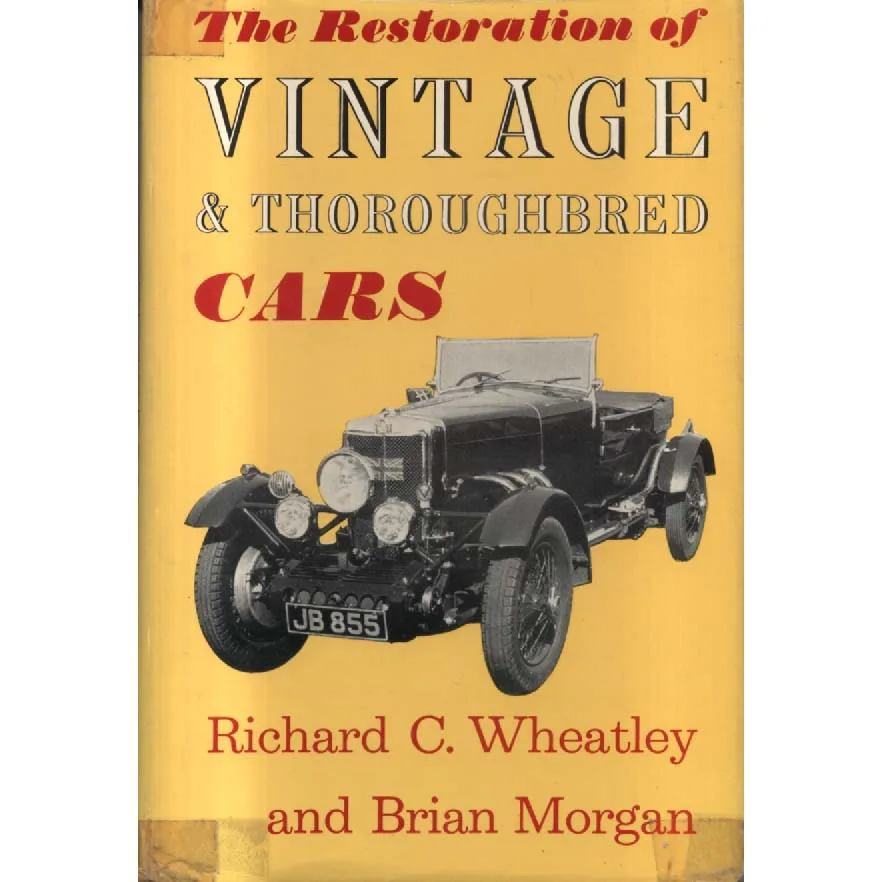
Vintage And Thoroughbred Cars
Publisher: BT Batsford Ltd
Format: Hardback
ISBN: none
Vintage and Thoroughbred Cars (1960) — Richard C. Wheatley
B. T. Batsford Ltd • ISBN: none • Condition: Good • Offered by Crappy Old Books
Here is the handbook for people who think a bonnet strap is a personality trait. Richard C. Wheatley’s Vintage and Thoroughbred Cars (1960) is the civilised clink of spanners in print, a book that polishes its own adjectives and then asks if you’ve considered a slightly taller tyre. It’s the era when cars were not “platforms” but temperamental aristocrats: big-chested radiators, coachwork with cheekbones, and mascots pointing confidently at the horizon as if the map were optional.
Wheatley writes like a club secretary who has seen things—quietly amused, technically alert, and unable to resist a well-bred torque figure. He strolls through the paddock of the great and the gloriously fussy: Bentleys that consider hills a personal affront, Bugattis with nerves of piano wire, Lagondas with unembarrassed lung capacity, Alvis with sly engineering, and a supporting cast of Rileys, Talbots, and other cars that pronounce “sports” with an extra syllable. Expect crisp descriptions of triple carburettors that have never quite forgiven modernity, magnetos that demand both respect and biscuits, and gearboxes that prefer conversation to force.
Illustrations and photographs appear like old family portraits—everyone upright, impeccably lit, slightly surprised by electricity. The captions are modest, the knowledge unfussy, the opinions just tart enough to be useful. You’ll find the taxonomy of “vintage,” “post-vintage,” and “thoroughbred” laid out with the calm of a librarian who can also heel-and-toe. There’s advice on maintenance that treats oil as a love language and an unspoken faith that a well-timed decoke can improve one’s character.
Condition: Good—by which we mean the book has done some dignified mileage. The binding is straighter than a concours judge’s tie; the pages are clean with the light, even toning of a well-rested tweed jacket; the cover shows honest shelfwear—the kind you’d call patina if it were a bonnet. If a dust jacket is present, it has learned the ancient art of surviving bookcases; if not, the boards carry themselves like a chassis without a body: unadorned, structurally sound, and faintly heroic. No ISBN, of course—1960 was that marvellous, pre-bureaucratic era when books entered society the way a W. O. Bentley entered Brooklands: with confidence and a loud opinion on bearings.
Because this specimen comes to you from Crappy Old Books, rest assured we have not subjected it to a “book spa,” aromatherapy, or an inspirational-bookmark incident. We admired the typography, saluted the diagrams, and left its history intact. There may be a faint bouquet of library, linen cupboard, and distant garage—proof that the volume has lived where conversation and machinery overlap.
Read a chapter and you will begin assigning coachbuilders to ordinary objects. Read two and you’ll worry about the camber of your hallway rug. By the third, you will have developed views on the correct diameter of a steering wheel for one’s moral development. Wheatley is that persuasive: you don’t so much finish the book as you throttle back gently and check your plugs.
File under mechanical manners, pre-war poise, how to speak carburettor in public. Park it next to your rally badges, a pencil that always needs sharpening, and a free afternoon for contemplating axle ratios. When someone asks why you’re smiling at a drawing of a crossflow head, say the obvious: because elegance, when properly lubricated, still outruns fashion.
Keep browsing: See more Transport books Other books by Richard C Wheatley
